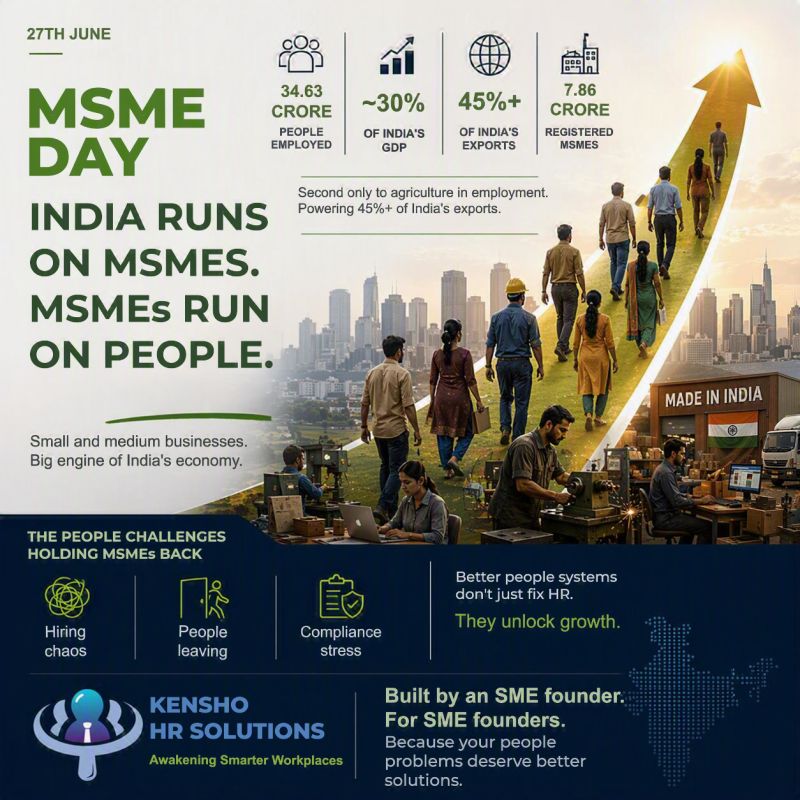
Summary: International MSME Day, observed on 27 June, marks the engine of India's economy. As of February 2026, 7.86 crore registered MSMEs employ 34.63 crore people (Ministry of MSME, Udyam data) — second only to agriculture, contributing roughly 30% of GDP and around 45% of exports. Yet a quiet inequality runs through this success story: MSMEs are the most underserved segment when it comes to HR services, and they face the highest concentration of talent and people problems — even as they power nearly half the country's exports. Large corporates give their employees structured HR, professional onboarding, compliance cover, and people systems. The 34 crore people working in MSMEs, and the founders who employ them, rarely have access to any of it. Kensho exists to fill that gap. This article looks at the scale of India's MSME workforce, the HR access gap they face, how AI is reshaping the sector and making upskilling non-negotiable, and how that gap can finally be closed.
Every 27 June, the world marks International MSME Day — the United Nations' recognition of micro, small, and medium enterprises as the backbone of economies everywhere.
Nowhere is that truer than in India.
But behind the celebration sits an uncomfortable question that the HR industry rarely asks: if MSMEs employ more Indians than any sector except agriculture, why do almost none of those employees have access to the kind of HR support that corporate employees take for granted?
That gap is the story worth telling on MSME Day. Not just how far the sector has come, but who has been left behind in the way we support its people.
1. How Big Is India's MSME Workforce, Really?
The direct answer: as of February 2026, India has 7.86 crore registered MSMEs employing 34.63 crore people, making the sector the country's second-largest employer after agriculture.
The numbers are staggering when you sit with them:
- 7.86 crore MSMEs were registered on the Udyam Registration Portal and Udyam Assist Platform as of 27 February 2026 (Ministry of MSME).
- 34.63 crore people are employed across these enterprises — more than the entire population of the United States.
- The sector contributes roughly 30% of India's GDP, around 35.4% of manufacturing output, and over 45% of exports (Union Budget 2026-27 / Ministry of MSME).
- The pace of formalisation has been extraordinary. Registered employment grew from 24.14 crore in December 2024 to 34.63 crore by February 2026 (Ministry of MSME, Udyam data) — a reflection of how rapidly the informal is becoming formal.
To put the growth in perspective: registered MSME employment on the Udyam platform has climbed from roughly 20.39 crore in mid-2024 to 34.63 crore in early 2026 (Ministry of MSME). That is not incremental growth. That is an economy formalising in real time.
These are not abstract statistics. They represent 34 crore individuals — machine operators, junior accountants, field sales staff, customer support agents, designers, delivery coordinators — who go to work every day at a small or medium business that is, in most cases, building its people systems on the fly.
2. The HR Access Gap Nobody Talks About
The direct answer: MSMEs are the most underserved segment when it comes to HR services, while facing the highest concentration of talent and people problems of any part of the economy.
Here is the paradox at the heart of MSME Day. The sector that powers nearly 45% of India's exports and employs 34 crore people is also the sector with the least access to professional HR support — and the one carrying the heaviest load of people problems.
Walk into any large Indian corporate and you will find a fully resourced people function. Structured onboarding. Defined career paths. Grievance mechanisms. Employee assistance programmes. Learning budgets. Performance frameworks. Compliance handled by specialists. A dedicated HR business partner for every department.
Now walk into a typical 40-person MSME.
The "HR function" is often the founder, doing it between sales calls. Onboarding is a laptop and a WhatsApp group. Compliance is whatever the accountant remembers to file. There is no grievance process, no structured feedback, no learning budget, and no one whose actual job is to look after the people who make the business run.
This is not because MSME founders care less about their people. In my experience, they often care more — they know their employees by name, they have eaten meals together, they have grown the business shoulder to shoulder. The gap is not one of intent. It is one of access.
The result is a two-tier reality. A talented young professional at a large corporate gets a structured first 90 days, a mentor, and a clear growth path. An equally talented person at an MSME gets a desk and a "figure it out." Same ambition. Same potential. Wildly different support.
And it is not only the employees who lose. The founders carry the entire people function on their own backs — hiring, firing, disputes, compliance, retention — on top of actually running the business. This is exactly why so many growing businesses start to slow down and feel chaotic after they cross 50 employees. The founder becomes the bottleneck for every people decision, because there is no system and no support.
3. Why the Gap Exists — And Why It Persists
The direct answer: MSMEs are priced out of traditional HR, under-served by enterprise providers, and too time-poor to build people systems themselves.
Three structural reasons keep this gap open:
The outcome: the sector employing 34 crore Indians is also the sector with the least access to professional people support. The engine of the economy is running without the very systems that would let it run smoothly.
4. AI Is Rewriting the MSME Playbook — And the People Inside It
The direct answer: AI is rapidly changing how MSMEs operate, and the people who work in them must be upskilled and retrained to stay relevant — or risk being left behind as roles transform.
Something fundamental is shifting in how small businesses run. AI is no longer a large-corporate luxury. MSMEs are using it for customer support, content, bookkeeping, lead generation, inventory, and a dozen daily tasks that used to take a person hours. India's AI adoption is now mainstream — 87% of enterprises are actively using AI solutions as of December 2025 (NASSCOM AI Adoption Index), and 43% of the Indian workforce used AI in their organisations over the past year (Deloitte-NASSCOM).
This is reshaping the MSME workforce in two directions at once.
On one hand, the opportunity is real and immediate. Generative AI tools boost productivity by 14% overall, and by 34% among new or lower-skilled workers (as cited by PIB / Ministry data) — which means AI can actually help close skill gaps inside small teams, lifting junior and less-experienced employees faster than ever before. For an MSME that cannot afford deep specialist benches, this is genuinely powerful.
On the other hand, the risk is just as real. NASSCOM estimates that 60–65% of India's current workforce will need significant reskilling by 2030, and workplace skills are becoming obsolete 70% faster than previously predicted (NASSCOM / industry research). For MSME employees — who already have the least access to structured learning and development — this is an existential question. If a corporate employee has a learning budget, an L&D team, and a manager guiding their growth, while an MSME employee has none of those, who is more likely to stay relevant as their role transforms?
This is where the HR access gap becomes a survival gap.
The MSME employees who power 45% of India's exports cannot be left to navigate the AI transition alone. And the founders who employ them cannot afford a workforce whose skills are quietly going obsolete while the business races to adopt new tools. The answer is not to fear AI — it is to build the people systems that help employees adapt to it:
This is people work. It is exactly the kind of strategic HR that MSMEs have never had access to — and exactly the kind they now need most urgently. Upskilling is not a perk for the AI era. For MSME employees, it is the difference between staying relevant and being left behind. Investing in your people's growth is one of the highest-return moves a growing business can make — and in the AI era, it has become non-negotiable.
Where Does Your People Function Actually Stand?
The Kensho HR Health Audit covers six HR pillars in about 10 minutes — including how ready your team is for what's next. Free, instant results.
Take the Free HR Audit →5. Closing the Gap: HR Built for the MSME Reality
The direct answer: MSMEs do not need a watered-down version of corporate HR — they need HR designed specifically for their scale, their budgets, and their stage of growth.
This is the gap Kensho exists to close. We live and breathe MSME.
We are not an enterprise HR firm that occasionally takes on smaller clients. The MSME is who we are built for — their scale, their budgets, their stage of growth, their particular brand of chaos. We understand it because it is the only thing we do.
The idea is simple. The same quality of HR thinking that a large corporate gets from an expensive in-house team can be delivered to an MSME through a fractional, outsourced model — at a fraction of the cost, and built for the realities of a 20–500 person business.
In practice, that means an MSME can finally access:
All without hiring a full-time HR head. All designed for the budget and the pace of a growing business. This is the entire premise of fractional HR — senior-level people support, sized and priced for the businesses that need it most.
Because the 34 crore people who power India's MSME sector deserve the same quality of HR care as anyone working in a glass-tower corporate. And the founders who employ them deserve to stop carrying the entire people function alone.
6. The Real Meaning of MSME Day
The direct answer: celebrating MSMEs means investing in the people who power them — not just the enterprises themselves.
It is easy to mark MSME Day with statistics about GDP and exports. Those numbers matter. But behind every percentage point of GDP is a person — a first-time employee, a floor supervisor, a young graduate at their first small-company job, a founder who has not taken a proper holiday in three years.
The next chapter of India's MSME growth story will not be written by credit schemes and registration portals alone, vital as they are. It will be written by whether the people inside these 7.86 crore enterprises are supported, developed, and retained well enough for the businesses to scale.
That is a people problem. And people problems have solutions.
This MSME Day, Start With Your People
If you run an MSME and you have been carrying the entire HR load yourself — or letting it slide because there was never time or budget for more — this is the year to change that.
Start with the free HR Health Audit. In about 10 minutes, across six HR pillars, you will see exactly where your people function stands — what is working, what is at risk, and what to fix first. No cost, instant results.
Or explore how Kensho delivers corporate-grade HR to Indian MSMEs — onboarding, compliance, recruitment, and retention systems, owned for you, priced for your reality.
Because the businesses that employ 34 crore Indians have spent decades powering this economy. It is time their people had HR worthy of that contribution.